Saturday, March 1, 2008

Resentment is like taking poison

What Makes Forgiveness So Hard?

Forgiveness versus Resentment

Why Forgiveness is so Hard? And how we can change? Human behavior that suggests that people are “hard-wired" to experience ruptured relational bonds, psychological distance, physiological arousal, and the desire to retaliate when they have been hurt by another person. Our pride or self-esteem is injured. Our expectations or dreams are disappointed. We lose something very valuable to us. We want recompense for the damages.

What are the other resistances which block our motivation to forgive?

1. Automatic thoughts or beliefs: What automatic thoughts or beliefs do we have that would impede us from forgiving others? We tell ourselves, "I won't forgive because he/she never accepts responsibility for what he/she does" or "I would be a hypocrite if I forgave because I do not feel like forgiving" or "Forgiving is only for weak people".

2. Explanations for behavior: When someone hurts us or lets us down....how do we generally explain his/her behavior? We Tend to assign internal causes for behavior to others: personality or character traits:

“He’s just so forgetful or careless” “She doesn’t appreciate me” “She did that purposefully” We judge them harshly.
When we do something wrong or hurtful/disappointing...how do we generally explain our behavior? We tend to excuse our own behavior by attributing external causes: “My child made a mess” “There was a car accident on the highway.” We tend to let ourselves off the hook and give ourselves permission to fail.

This is called the Fundamental Attribution Error...when we assign total
responsibility/blame to others/spouses for their behavior while explaining away our own negative actions in terms of situational factors.

Understanding and accepting the error in the Fundamental Attribution Error does not relieve offending people of moral responsibility. The goal is to promote empathy and forgiveness and look more realistically at the hurtful events from their point of view...”thinking the best” as 1 Cor. 13:7 reads: "Love always hopes, always trusts..." and using the Causal Agnosticism exercise: “one can never know the precise causes of a
person's/spouse’s hurtful behavior...

3. Lack of empathy (empathy is the psychological highway to forgive others) for others....
We need to develop empathy for others by beginning to change Fundamental Attribution Error way of thinking we have about people’s actions to a more empathic view and use the Causal agnosticism exercise which says, "One can never know the precise causes of another person's behavior".

When have you been able to have empathy for someone who has hurt you? Ask yourself “do I want things bitter or better?” Recall when you have needed forgiveness....

Don't let resentment imprison you for life. Resentment is like taking poison and expecting the other person to die. It will destroy you and your other relationships. Lewis Smedes wrote: "To forgive is to set the prisoner free...and to discover that the prisoner was you."

Let go of the pain. Give it to God. For God alone understands more than anyone the pain and humiliation you feel. Jesus felt more pain, rejection and humiliation than any person. He came unto His own and His own did not receive Him. Not only did the created not receive the Creator, they tortured him and put him to death... on a cross.

Phil 2:5-8 Your attitude should be the same as that of Christ Jesus: Who, being in very nature God, did not consider equality with God something to be grasped, but made himself nothing, taking the very nature of a servant, being made in human likeness. And being found in appearance as a man, he humbled himself and became obedient to death-- even death on a cross! (NIV)

And then Jesus said as He hung on the cross dying for our sins, "Father, forgive them for they know not what they do".

May God give you the grace to forgive. To not only set the other person free but to set yourself free from the past and to become more like Christ.

© copyright 2007 by Lynette J. Hoy, NCC, LCPC

Be released from the grip of bitterness!

Forgiveness is a Choice

Choosing to Forgive

Forgiveness is not easy. It can be painful. Actually, from God's perspective, forgiveness had a great price..the death of His one and only Son. But our forgiveness towards another human being doesn't cost us our lives. It may cost us our pride, giving up retribution towards them and the loss of personal belongings. Certainly, you can forgive someone for past offenses but still hold him or her accountable for present responsibilities.

Here are some guidelines and scriptures which will help you as you consider forgiving someone and letting go of the past hurts.

  1. Deal constructively with the root cause of anger towards the person... Proverbs 29:11
    a. Ask: What am I angry about? What is my responsibility? What is his or her responsibility?
    b. Forego Retribution: "Do not repay evil for evil . . ." (Romans 12:17-18) "... overcome evil with good." (Romans 12:19-21)
    c. Pour out your anger to God & leave it there. (Psalm 10:1-18)
  2. Plan a constructive confrontation (Matthew 18:15)
    a. Apologize, if appropriate (Matthew 7:1-5)
    b. Use a soft, loving approach. Think about how much God loves you & has forgiven you (Ephesians 4:32; Psalm 103: 11-12).
    c. Be honest, yet tactful (Ephesians 4:15,25)
    d. Indicate the behavior change needed
  3. Choose to forgive
    a. Release him or her from guilt & bondage (Ephesians 4:32-5:2)
    b. Let go of your demands on this person
  4. Return good to him or her (Matthew 5:43-46)
  5. Depend on the power of Christ to change your attitude towards the person. (Philippians 4:13)

    Forgiveness is worth it! When all is said and done.....you have to give up the power, the pride, the hurt because you need to be released from the grip of bitterness. And the other person needs your unconditional love. "Love cover a multitude of sins" 1 Peter 4:8
    Then you will discover that "forgiveness is a choice you make based on the forgiveness you have already received in Christ."

    Order and read the following:
    1. The Healing Power of Forgiveness by Dr. Ray Pritchard
    2. What's Good About Anger? anger management books and certificate courses These books and programs teach how to turn your anger into faith, assertiveness, problem-solving, conflict management and forgiveness!
    3. To Forgive is Human : How to Put Your Past in the Past by Michael E. McCullough, Everett L. Worthington (Contributor), Steven Sandage (Contributor)
    4. The Freedom & Power of Forgiveness by John MacArthur

    © copyright 2007 by Lynette J. Hoy, NCC, LCPC

Forgiveness cancels a debt someone owes us and restores relationship.

The Power of Forgiveness as published in The Godly Business Woman magazine's Jan/Feb 2002 issue. © copyright 2002 by Lynette J. Hoy, NCC, LCPC

It's challenging to think about forgiving people who have hurt us, isn't it? We don't want to let go of the painful memories of abuse, put-downs, broken promises, harsh words, family or work offenses.

One outstanding example of forgiveness occurred when Corrie Ten Boom met a former Nazi Officer who had abused her and her sister during imprisonment, assisting in the death of other prisoners. He told her he had become a Christian and proceeded to ask Corrie to forgive him. As he reached out his hand towards her,

Corrie resisted. Then, in obedience to God, as she extended her hand towards him she felt the surge of the Holy Spirit pour through her in a supernatural act of forgiveness.

Chuck Colson tells the story about a Mrs. Washington who, during a graduation ceremony for inmates completing a Prison Fellowship program, swept to the stage to wrap her arms around a graduating inmate, declaring "this young man is my adopted son." Everyone had tears in their eyes for they knew that this young man was behind bars for the murder of Mrs. Washington's daughter.

Accounts like this are amazing! How could people like Corrie and Mrs.Washington endure such great injustices and then turn around to forgive the villains? Yet all they did was purely obey the command: "forgive each other, just as in Christ God forgave you." Ephesians 4:32

Phillip Yancey wrote: "Forgiveness is another way of admitting, 'I'm human, I make mistakes, I want to be granted that privilege and so I grant you that privilege.' "

Forgiveness cancels a debt someone owes us and restores relationship. It is the only solution in a world ridden with sin and evil to help us start over with people and with God.

We learn about real forgiveness at the foot of the cross where Jesus Christ shed His blood to pay for the sins of the whole world. That is God's kind of forgiveness- - free, sacrificial, no cost on our part.

When we experience His forgiveness we want to obey Him like Corrie and Mrs. Washington, extending that forgiveness to others.

So, how do we practically forgive someone who has hurt us? Here are some Steps to Forgivingness. Applying these steps to our lives can help deliver us from bitterness and work towards forgiveness:

1. We need to know and experience Christ's love and forgiveness deeply in our own lives. Col. 3:13

2. We can make the choice to forgive. When Corrie Ten Boom extended her hand to the former Nazi officer, she did it choosing to follow Christ versus her feelings. Paul writes in Eph 4:31-32 "Be kind and compassionate to one another, forgiving each other, just as in Christ God forgave you."NIV

3. Christ can help us overcome negative thoughts and beliefs which block forgiveness. We can ask Him to soften our hearts and change our minds towards that person, granting us the power to forgive him/her. Phil. 4:8, 13

4. We can recognize that we are sinners in need of forgiveness. This helps us empathize with those who have injured us. Mrs. Washington's acceptance of her daughter's killer was based on her realization that she was a sinner in need of grace as well. Paul writes in Rom 15:7-8

"Accept one another, then, just as Christ accepted you, in order to bring praise to God."

5. The Holy Spirit can empower us, when we surrender to Him daily, with the fruits of love, joy, peace, patience, kindness, self-control towards those who have hurt us. Gal. 5:22-3

6. When it's still hard to forgive, we can place our trust in God Who will someday judge all the wrongs in the world. We can leave revenge and ustice up to Him..... because Proverbs 20:22 says "Do not say, "I'll pay you back for this wrong!" Wait for the Lord, and He will deliver you." and Paul writes in Romans 12:19 Do not take revenge, my friends, but leave room for God's wrath, for it is written: "It is mine to avenge; I will repay," says the Lord.

7. When we are stuck in unforgiveness, we can ask to talk and pray with a confidante, a pastor or a counselor to help us deal with the resentment and hurt we feel towards the offender. This will provide a context for release of the painful feelings we are experiencing, provide support, and a better understanding of the person and situation.

When others hurt or abuse us, disrespect or humiliate us, we can forgive them as Corrie and Mrs. Washington did. God, Himself, is the power behind our ability to forgive. He can enable us to do the impossible: "for it is God who works in you to will and to act according to his good purpose". Phil 2:13

Perhaps the most powerful outcome of forgiveness is that it changes and enables us to become more like Christ Who said as He hung dying on the cross... "Father, forgive them for they know not what they do."

God's love and grace is the power behind forgiveness, granting us supernatural power to forgive others, the power to overcome resentment, the power to redeem relationships and show God's love to a hurting world.

© copyright 2001 by Lynette J. Hoy, NCC, LCPC as published in The Godly Business Woman magazine's Jan/Feb 2002 issue.

Order the What's Good About Anger? anger management courses and certificates this book and program teaches you how to turn your anger into faith, assertiveness, problem-solving and forgiveness!

Lynette J. Hoy is a Marriage and Family Counselor in private practice in Oak Park, Illinois. Lynette regularly presents seminars on: women's issues, assertiveness, "What's Good About Anger?", stress and conflict management, PREP's "Fighting for Your Marriage", grief and divorce recovery. Lynette is a National Certified Counselor and the Chairwoman of CBWC: Chicago-land's Connecting Business Women to Christ. Contact her for seminars, articles or counseling needs at counselor@hoyweb.com or 708-524-3333. See web sites: www.hoyweb.com , www.counselcareconnection.org .


Friday, February 29, 2008

Disillusioned with organized religion?

Americans are switching denominations

A panoramic snapshot of American religious life in 2008 reveals an extraordinary dynamism that is reshaping the country's major traditions in historic ways.

Almost half of Americans have moved to a different religious denomination from that in which they were raised, and 28 percent have switched to a different major tradition or to no religion (i.e., from Roman Catholic to Protestant, Jewish to unaffiliated).

The fluidity is combining with immigration to spur dramatic changes in the religious landscape. Protestantism appears on the verge of losing its majority status. The number of "unaffiliated" Americans has doubled, to 16 percent. One-third of Catholics are now Latino, and the religion is depending on immigration to maintain its share of the population.

These shifts are captured in a survey released by the Pew Forum on Religion & Public Life.

"The extent of change in the American religious marketplace is remarkable," says Luis Lugo, the Pew Forum's director, in an interview. "Everyone is losing and has difficulty retaining childhood members, but everyone is also gaining."

The report is the first of three Pew will release this year from a path breaking survey of the U.S. religious landscape. Based on interviews in English or Spanish with a representative sample of 35,000 adults, it describes America's religious composition and the changes under way. Later this spring, the second report will analyze Americans' beliefs and practices, and the third, their social and political values.

The movement between churches and denominations is not new, but the report documents its remarkable scope.

"Religious fluidity is part of a larger picture of fluidity in American life generally," says Wade Clark Roof, author of "Spiritual Marketplace" and professor at the University of California at Santa Barbara. "You can read this as 'It's what America is about -- we choose' ... The downside is enormous instability, lack of grounding, wandering in the wilderness."

Observers point to many reasons for the shifts. People may change churches because they relocate to a part of the country where different denominations predominate, or they may prefer another style of worship. Whatever the reasons, the survey reveals some clear winners and losers.

Protestantism, which has shaped American identity for generations, may soon become a minority faith. In the 1980s, 65 percent of Americans called themselves Protestants; today that number is down to 51 percent. Only 43 percent of those aged 18-29 say they are Protestant.

Much has been written about the declines in mainline churches. But in comparing the current religious affiliation of adults with their childhood affiliations, the survey found a net loss of 3.7 percent for Baptists (Baptists account for one-third of all Protestants and nearly two-thirds of black Protestant churches.)

Perhaps the big surprise, though, relates to Roman Catholicism, which experienced the greatest net loss. While 31.4 percent of adults say they were raised Catholic, today only 23.9 percent identify as Catholic, a net loss of 7.5 percent.

"The Catholic numbers are eye-popping," Lugo said. "One out of every 10 people you meet on the street is a former Catholic."

Fortunately for the Catholic Church, however, its share of the religious pie has remained steady in recent decades, due partly to conversions but largely to immigration. Catholics account for 24 percent of the adult population, but immigration could well boost its future share.

"Within our society, Protestants basically outnumber Catholics 2 to 1," Lugo says. "Among immigrants, it's the reverse: Catholics outnumber Protestants by more than 2 to 1."

The big winner on the shifting religious scene is the group of "unaffiliated" Americans. Today 16.1 percent of adults fit that category. Among young people 18 to 29, one-quarter are unaffiliated.

It's common for young adults completing education or starting careers to become detached from their faith connection. Other people may become disillusioned with organized religion.

"Scandals and conflicts lead some to distance themselves, even though they still hold Christian beliefs," says Darren Sherkat, a sociologist at Southern Illinois University in Carbondale, who has studied the unaffiliated. "A perhaps growing percentage are disaffiliated because they don't hold Christian beliefs."

The survey found that 1.6 percent of adults call themselves atheists and 2.4 percent are agnostics (who consider God to be unknowable). The remaining 12 percent in "unaffiliated" split almost evenly between the secular and the religious, who may practice their faith on their own.

Although this category is growing the fastest, the survey shows that about half of the unaffiliated end up returning to a faith connection. Other research, however, indicates that many young people today are disaffected from Christianity, and religious leaders worry that they won't follow the usual return pattern.

Currently Christianity retains the allegiance of 78 percent of Americans. Nondenominational churches are growing and attracting about 5 percent of adults.

Other world faiths also now account for 5 percent of the population. Their net losses or gains in affiliation were relatively small: Jews dropped by 0.2 percent, Muslims gained by 0.1 percent, Buddhists gained by 0.3 percent and Hindus showed no change.

E.W. Scripps Co.
© 2007 Abilene Reporter-News

Is God real and relevant?

Veritas forum explores empirical proof of the Bible

By: Lindsey Coyne

Posted: 2/29/08

Last week, the Christian Faculty and Staff Network, along with several student organizations, had Texas A&M's annual Veritas forum. The Veritas forum, a nationally headquartered team, presents forums at universities across the nation in order to instill the relevance of Jesus Christ in all aspects of life. The forum took place on two evenings and featured two keynote speakers addressing the question and ultimate validity of God in the universe.

The first of these speakers, Walter Bradley, a professor of mechanical behavior of materials at Baylor University and former A&M professor of mechanical engineering, gave scientific evidence of the complex characteristics of the universe in his presentation, "The Bio-Friendly Universe: By Design?"

Bradley said his research in this field is to highlight "what about the universe makes it a place for complex life forms." His findings run the gamut of formulas and figures across chemistry, physics and genetics. Ultimately, the whole of the evidence provided by Bradley demonstrated that if there were an absence of certain value-specific universal constants, this planet would be incapable of supporting human life. Specifically, the values associated to the amount of "dark energy" present at the Big Bang is precisely what is needed for the universe to form. Bradley equates his interest and research in this field to his own personal beliefs in Christian deism. Within the past 15 years, everything he has found has reinforced his beliefs.

"Nothing about our universe is random, chaotic or purposeless," Bradley said, even though the deductions of past scientists suggest otherwise. Bradley co-authored a book, The Mystery of Life's Origins, based on these findings, and has presented this information in forums on more than 100 college campuses to more than 40,000 students nationwide.

Sherri Verm, a senior political science major, found the information contained in Bradley's presentation quite remarkable.

"I decided to attend because I found it very interesting that science and math could potentially work together to prove some element of theology," Verm said. She said she identified with the simple analogy Bradley offered the crowd about the chances of rolling a die 100 times and getting a six to make the emphasis about how unique, diverse and deliberate the constants of the universe actually are.

"Dr. Bradley's explanations have solidified my beliefs even more with unquestionable proof that there is a higher being at work in the universe," Verm said.

The second of the two featured speakers at the Veritas forum was A&M's Stephen McDaniel, professor of marketing and assistant department head in the Mays Business School. His presentation, "How Do We Know the Bible is True? Evidence from the Dead Sea Scrolls and Other Archaeological Findings," focused on the unearthing of the Dead Sea Scrolls and what they prove about the legitimacy of the Old Testament.

The scrolls, discovered in 1946 in a cave in Qumran near the northwestern part of the Dead Sea, have actually disproved numerous assumptions about the inaccuracy of Old Testament divinations. These scrolls include, among other biblical and archaeological findings, more than 230 copies of biblical texts and commentaries including the books of Habakkuk, Nahum, Psalms and Genesis. McDaniel highlighted two benefits in the findings of these scrolls.

"[Manuscripts] show how accurate scribes were in making copies of the Bible through the years," McDaniel said. "The scrolls validate Old Testament prophecies."

Critics of the provable existence of Jesus Christ have argued that prophecies about Jesus were added more than 900 years after his death, insinuating that New Testament scribes rewrote history to serve their beliefs in God. Once these scrolls were found and the Dead Sea Scroll Committee translated the manuscripts, they found prophecies about the birth and life of Christ that predate his existence by more than 100 years.

McDaniel, a self-professed researcher by nature, began his quest for the truth of these scrolls based on his need for empirical proof of his religious beliefs. He traveled to Qumran and took tours of Egypt and Israel to see firsthand the geographical setting of the biblical stories he had come to know so well. To this day, he has maintained his interest in the Dead Sea Scrolls as the discoveries about their content and subsequent evidence increase.

In attendance of McDaniel's presentation was Kristen West, marketing graduate student.

"His summary of the significance of the findings of the scrolls was what I appreciated the most," West said.

Another point that impacted West was the fact that the scrolls show prophetic evidence of the life of Christ years before he was born.

"The presentation enhanced my beliefs and gave me an accurate point of reference when describing my faith to someone else," she said.


© Copyright 2008 The Battalion


Tuesday, February 26, 2008

How to Destroy Your Marriage!

Marital Mistake: Igniting Fires with an Untamed Tongue

Dr. David B. Hawkins

Fire is one of those elements that can either be our friend, keeping us warm and dry, or our foe, creating incomparable damage. Likewise, the tongue can either encourage or destroy. As the Apostle James said, "With the tongue we praise our Lord and Father, and with it we curse men, who have been made in God’s likeness." (James 3: 9) James goes on to say the tongue is like a spark that can set a mighty forest ablaze.

Fire creates searing heat. Perhaps more destructively, however, is the fact that fire consumes the oxygen needed to survive. Fire robs us of life just as the tongue can set a mortal blaze in our marriages, stealing vitality from our life.

For any fire to continue it needs fuel. Thankfully, fire cannot burn on its own. I received a vivid lesson about fire and fuel one warm summer day when I was about ten years old. I was lying in the tall grass behind my house with a couple of buddies. With stalks of dried grass hanging out of our mouths we were telling stories and enjoying ourselves. Life couldn’t have been sweeter.

To ten-year olds, those stalks of grass were temptingly similar to a forbidden cigarette and one of us wondered what it would be like to "smoke" a few of those blades of grass. It all seemed innocent enough. We gathered our "cigarettes" and proceeded to light up. Suddenly, without warning, a spark caught in a bundle of dried grass, and then another, until we were faced with an inferno beyond our control. Realizing the potential danger of the fire, we ran for the help of my dad. Three screaming boys immediately caught his attention. We formed a "bucket brigade" and were able to douse the fire and get on to the next important issue—explaining all of this to my very angry father.

An innocent outing, an impulsive act, a furious outburst of potential danger. We contained the problem quickly and limited the damage.

Like that field, a marriage can become tinder dry at times, ready for a spark to ignite things. A season of dryness, or ongoing conflict, can set the stage for an angry outburst of deadly proportions.

"But, I just can’t help it," twenty-seven year old Karen said recently. "I just get so mad that I say what’s on the top of my mind. I know I can be extremely hurtful. We have called each other the most horrible names, and are embarrassed about it. We both have biting tongues, and know it."

Karen and Doug, clients of mine, were newly married and already having problems. I watched as Doug nodded his head to Karen’s rendition of the problem. I asked them to explain more about their problem.

"My husband and I can’t seem to agree on anything. I mention to him that I want more help around the house, and somehow we end up in World War III. I hate it."

"It’s true," Doug said soberly. "We don’t know how it happens, but when we fight, which is not all the time, it gets bad. We say things we would never say at other times, and we’ve nearly called it quits because of it."

"Well," I said slowly. "I have a saying—‘If it’s predictable, it’s preventable."

"It certainly is predictable," Karen said wryly. "The preventable part is questionable."

I could clearly see the pain Karen and Doug were in. They had hurt each other deeply with, impetuous, ill-spoken words.

"It takes a lot of self-control to slow things down enough to see what you two are doing so you can change the pattern."

"Doug is just as tired of my biting tongue as I am," Karen said.

"I can get pretty sarcastic and angry, too," Doug replied, "and we’re both tired of our bickering."

"Good," I said. "Being tired of how things are going is a great place for God to work in our lives. We have to get to the point where we are at our wits end—then God can step in."

We spent the rest of our session exploring the roots of their anger and biting tongues. We discussed how their anger and sharp words had caused tremendous pain in their marriage, to the point where they had nearly separated several times. It had scared both of them, and they wanted to learn new tools.

One of the tools I shared was "speaking from your most vulnerable self." This requires slowing down the process and exploring what other feelings could be shared rather than anger—which so often is hurtful. We discussed how anger is a secondary emotion, and how we need to look beneath the surface and learn to share other more vulnerable emotions that lay below the surface.

We discussed common underlying feelings known as GIFT:

• Guilt: anger often covers feelings of unexpressed guilt.

• Inferiority: anger often covers feelings of insecurity or inferiority.

• Fear: this is often an emotion that is difficult to express, but can be powerful when expressed appropriately.

• Trauma: conflicts often reawaken previous trauma in your life, creating hypersensitivity to an issue.

Karen and Doug seemed relieved to hear that their problems were normal and could be remedied. They agreed to slow things down when they became defensive, to guard their tongues and to look deeply to see if there were other, more vulnerable emotions needing expression. They agreed to take time outs when needed. It would take work, but they agreed to take these new insights home to practice.

Are you using an untamed tongue in your marriage? Have you said things you regret later? Consider taming your tongue. Recognize and own your primary feelings, practice some of the tools in this article, and allow God to heal problems without anger and harsh words. You’ll be glad you did.

Editor's note: Do you need sound, Biblically-based advice on an issue in your marriage or family? Dr. David will address questions from Crosswalk readers in his weekly column. Submit your question to him at TheRelationshipDoctor@gmail.com.
_________________________________________________________
This article was adapted from Nine Critical Mistakes Most Couples Make (Harvest House Publishers, 2005).

Dr. David B. Hawkins is a Visiting Professor at International Christian University and specializes in interpersonal relationship counseling as well as domestic violence and emotional abuse in relationships. He has been a frequent guest on Moody Radio Mid-day Connection, Focus on the Family, and At Home Live. You can visit his website at www.YourRelationshipDoctor.com.

I’m not the person for a job like that!

What are Your God-Given Abilities?

Dan Miller

Remember when God spoke to Moses at the burning bush? God told Moses he wanted him to go back to Egypt and lead the people out to the promised land. Moses looked and said – “You’ve got to be kidding – I’m not the person for a job like that.” God assured Moses he would prepare the way and he would provide some pretty convincing miracles. Still Moses had a hard time believing he was up to the task. He pleaded – “I can’t speak well, I don’t have a college degree, I’m a convicted felon – please, send anyone else!”

Now here we have someone with an obvious opportunity. Wouldn’t you like for God to lay out such a clear plan for you; and to promise success in advance. That wasn’t good enough for Moses. He kept trying to convince God he didn’t have any of the necessary requirements for accomplishing this big job. Moses said “they won’t believe me. I don’t have anything to qualify me for doing something great.” God said, “What is that in your hand?” If you don’t remember, it was his shepherd’s staff, which turned out to be a pretty significant part of his leadership. He turned it into a snake, parted the Red Sea with it and did some other pretty cool stuff.

If you think you’re stuck, don’t have any unusual talents, don’t have the right degrees, and don’t have the credibility to have people take you seriously – let me ask you a question: “What do you have in your hand?” What natural talents do you have? What is it that you do with excellence? Do you make beautiful candles? Delicious bread? Encourage the elderly? Grow stunning flowers? Handle your children with grace? You get the idea – just look at what you have right in front of you.

With God’s help you may already have everything you need for greatness. Don’t balk when you hear your call!


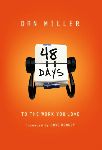
Dan Miller is President of The Business Source, founder of "48 Days" and author of 48 Days To The Work You Love and 48 Days To Creative Income. He is the growing authority for creating effective life plans that are achieved by integrating natural gifts, unique personality traits and one's own values and passions. His unique clarification of how God gifts us will introduce you to a new sense of freedom and fulfillment of your life's calling. For more information, visit http://www.48days.com/ .


Find this article at: http://www.christianity.com/christian living/features